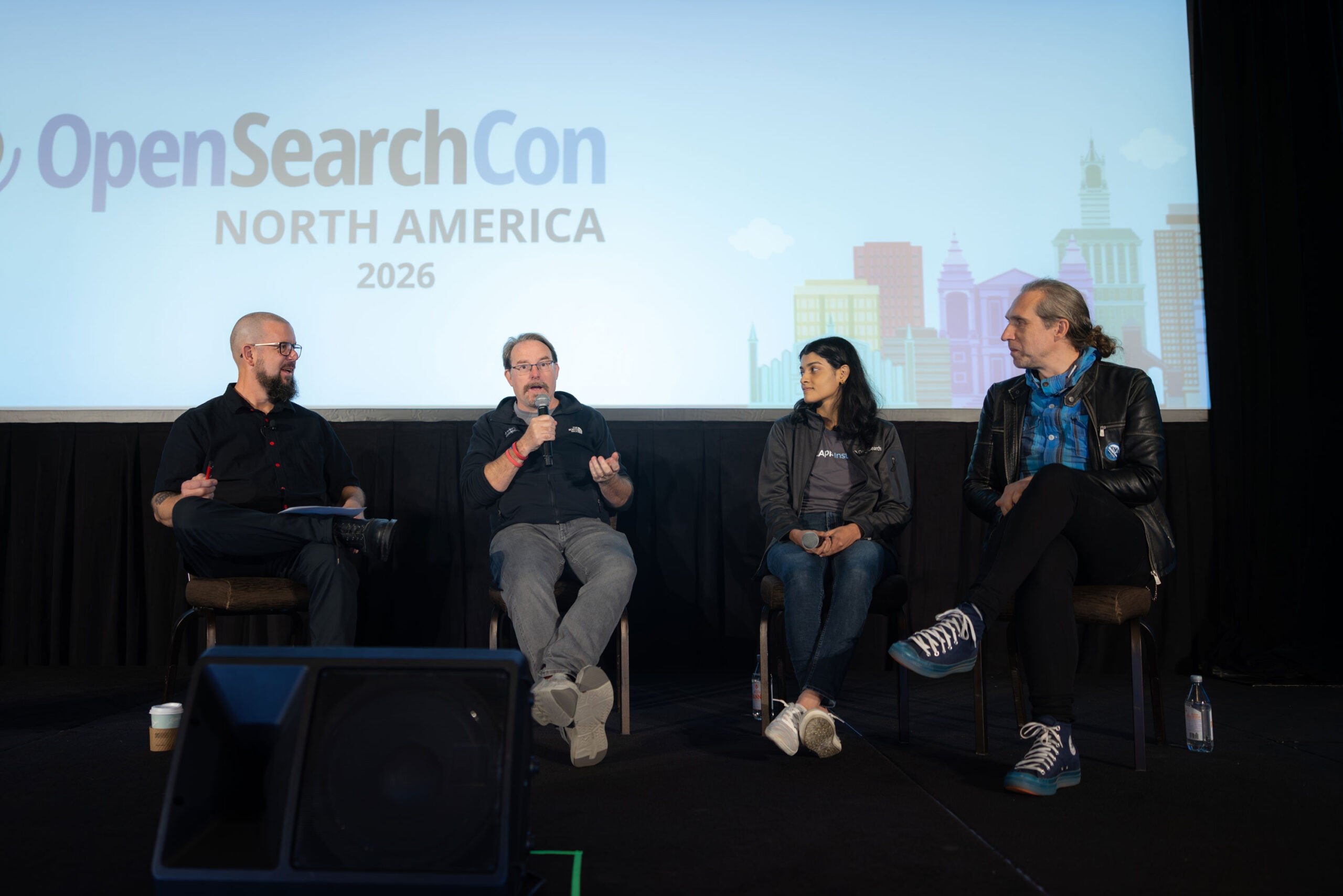
Insights and honest perspectives from the “Ask the Experts: Maintainer Panel” at OpenSearchCon North America 2026.
Open-source maintainers do far more than commit code. They serve as guides, community managers, mentors, and stewards for software used by millions worldwide. In September at OpenSearchCon North America, I brought together three open-source maintainers to share their personal journeys. We discussed what maintainership really entails and explored how the community can foster its next generation of leaders.
Meet the panel
- Kris Freedain – Senior Community Manager at the OpenSearch Project (Panel Moderator)
- Nils Bandener – OpenSearch Security Plugin Maintainer and Freelancer
- Ramya Ravi – AI Developer Advocate at NetApp Instaclustr
- Eric Pugh – Search Relevance Maintainer (UBI) and co-founder of OpenSource Connections
Unexpected journeys into maintainership
No two paths to becoming an open-source maintainer look the same. Whether through hands-on technical contributions, advocacy, or organic community conversations, maintainership often starts with a single step.
Nils Bandener: Nils started working on the OpenSearch Security plugin in 2024, focusing on testing framework improvements. Then he unexpectedly received an email from maintainer Craig Perkins inviting him to take the next step toward maintainership.
“My first question was: ‘What do you expect from me?’ I already had a full day of work and too many hobbies. Craig’s reply was, ‘Whatever you can offer.’ He didn’t set rigid standards: just whatever value I could bring.”
Nils Bandener
Ramya Ravi: Ramya began by creating technical content, documentation, and sample code at Instaclustr to help users adopt the software. After early contributions to PyTorch, she moved into reviewing OpenSearch pull requests and updating documentation.
Eric Pugh: Eric’s journey started with a conversation at the first OpenSearchCon, where he talked with the documentation team about tools like Jekyll and Docker setup.
“Next thing I knew, someone said, ‘Do you want to become a maintainer and help us move these PRs through a bit more smoothly?’ That baby step led to technical projects like User Behavior Insights (UBI).”
Eric Pugh
What do maintainers actually get out of it?
Open-source maintainership takes time and energy, but the rewards, both personal and professional, are substantial.
Trust and impact: Nils described the emotional reward of having a global community trust your judgment in critical infrastructure.
Professional standing: Eric compared becoming a maintainer to passing the bar exam or earning an architectural license.
“There are a million one-person projects on GitHub. But having your peers say, ‘We trust you,’ on a major project: that’s the software engineering equivalent of passing the bar.”
Eric Pugh
Social and economic value: Open source creates widespread value across society, giving contributors a tangible way to give back.
Key success stories and real-world impact
Maintainers and contributors measure their success by how their work helps real organizations. Each panelist talked about a project they worked on:
| Organization / area | Challenge / goal | Result / impact |
|---|---|---|
| Ramya and NetApp Instaclustr: Pegasystems and Store Wizards | Scaling real-time search queries | Saved 2,000+ hours of infrastructure management time. |
| Eric and OpenSource Connections: Fullscript | Migrating search infrastructure | Moved to OpenSearch for three reasons: pure open source, managed options, and User Behavior Insights (UBI). |
| Nils: Security Plugin | Performance bottlenecks | Transformed an exponential performance regression into a smooth, linear curve. |
Busting common open-source myths
The panel dispelled several widespread misconceptions about what it means to be a maintainer.
Myth 1: Being a maintainer is all about writing thousands of lines of code
The reality: The best maintainers focus on what makes the project better, whether that’s code review, project direction, documentation, or knowing when not to write code at all.
“It need not be a PR, it need not be 1,000 lines of code. It can just be sample code or a blog or something that makes people’s lives easier,” Ramya said.
“The best decisions are often when someone says, ‘Actually, we don’t need to write that. We already have this,’” Eric said. “It’s about looking at the project clear-eyed.”
Myth 2: Maintainership is purely technical
The reality: At a high level, maintainership is mostly about social skills and building community.
“On the first level, it’s an exercise of social skills,” Nils said. “You’re balancing community feedback, deciding what’s out of scope, and guiding contributors respectfully.”
Myth 3: Maintainers are responsible for fulfilling every enterprise feature request
The reality: Maintainers are guardians, not a full-service agency.
“We don’t balance feature requests from enterprises versus small users, because maintainers aren’t there to fulfill feature requests,” Nils said. “We are benevolent guardians offering advice and code review.”
Growing and diversifying the maintainer base
As large projects like OpenSearch grow quickly, bringing on new maintainers and preventing burnout is critical.
The Contribution Ladder: The OpenSearch Technical Steering Committee (TSC) introduced an official Contribution Ladder policy. It creates structured in-between roles, such as project “Members,” between casual contributors and full maintainers.
Maintainers’ responsibility to mentor: The panel stressed that current maintainers must actively mentor others, so that each repository has more diverse contributors across companies and organizations.
Start small: The panel advised newcomers not to open large refactoring pull requests right away. Instead, start by improving documentation, solving specific user issues on GitHub, writing technical blog posts, or answering community questions.
Watch the full video
The panel also covered topics for everyone from current maintainers to new open-source contributors starting their own path to maintainership. Watch the full video below to learn more about what was discussed.
More to come
The whole group really enjoyed the discussion on stage, and I believe the audience did too. I hope this is just the beginning of panels like this at future OpenSearchCons. We could hold them for maintainers of specific repositories, TAGs, user group organizers, and more. There are so many possibilities.