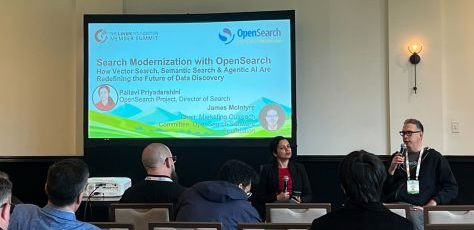
At the Linux Foundation Member Summit 2026 in Napa, CA, I had the pleasure of sitting down with James McIntyre, my colleague and chair of the Marketing Outreach Committee for the OpenSearch Software Foundation, for a fireside chat on search modernization and the role of the OpenSearch community in the era of agentic AI. Our conversation explored the forces reshaping enterprise search, the community-driven roadmap we recently published, and why open source software is uniquely positioned to lead through this period of disruption. Here are the key themes from our discussion.
The search stack is modernizing
Before generative AI entered the picture, the vast majority of enterprise search implementations relied on lexical models, systems optimized for keyword matching against structured data. In 2025, semantic search and vector databases became a defining trend, enabling search engines to understand user intent and the relationships between concepts rather than relying on exact term matches.
Today, those capabilities are table stakes. The conversation has shifted to the opportunity of agentic AI- autonomous workflows in which agents plan, reason, and iteratively retrieve information across multiple systems and data sources to answer queries and surface insights that simply were not possible before.
This evolution is driven by a stark underlying reality: an estimated 80% of enterprise data is unstructured and therefore trapped in documents, emails, wikis, code repositories, and collaboration tools. Straightforward document retrieval is no longer sufficient at enterprise scale, as it misses out on 80% of your data; Organizations require search infrastructure that can deliver actionable insights from vast and growing data stores across structured and unstructured sources, and they need it to work from plain language queries.
Search modernization is no longer a “nice to have.” It is existential. The organizations that figure out how to extract intelligence from their proprietary data are the ones set up for success.
Building the search engine for AI agents
Search infrastructure is now handling demands that did not exist a few years ago. AI agents have already emerged as a significant new class of search users who interact with search engines differently than humans do, straining the systems in different ways. Agents generate high volumes of short, fast queries at massive scale. Any search engine powering those interactions needs high performance, low latency, and resilience, and it needs to continue to improve because the volume of agent-to-engine interactions is growing exponentially.
The OpenSearch Project is positioning itself as the open source solution for building search engines optimized for AI agents, and we are approaching this from two directions.
First, the project is investing in the OpenSearch Core engine: performance, scalability, and low-latency retrieval, so that OpenSearch serves as the high-performance retrieval layer that agents depend on. Second, we are integrating with the agentic frameworks where production agents are actually built, including LangChain, AgentCore, and others. Whether building agents directly on OpenSearch using native Model Context Protocol (MCP) support and built-in tooling, or using OpenSearch as the retrieval engine within a higher-level framework, both paths are supported.
Security is foundational to this effort. OpenSearch provides document-level and field-level access controls enforced at the retrieval layer, ensuring that unauthorized content is excluded before it reaches ranking algorithms or generative models. The OpenSearch community treats security as a fundamental component of agentic AI, not an optional feature. In this era of AI, where agents interact with sensitive proprietary data, this zero-trust approach at the search engine level is critical infrastructure.
A community-driven roadmap guided by the Technical Steering Committee
The OpenSearch project recently published its 2026 public roadmap, which focuses the Project’s development on four pillars: search modernization, observability and analytics, scalability and resiliency, and community and platform. This roadmap was built collaboratively by contributors from across the OpenSearch community: Amazon, Uber, Apple, Salesforce, and many smaller organizations, most directly through the project’s Technical Steering Committee (TSC).
The TSC, composed of experts from multiple organizations, has been instrumental in defining these pillars and identifying where the project needs to invest. Their focus extends beyond core engine capabilities like performance and resiliency to encompass developer experience: how to make OpenSearch easier to develop on, easier to integrate with agentic coding assistants, and easier to deploy without extensive setup. These are the kinds of questions the TSC is driving, and the roadmap reflects that breadth of thinking.
The momentum behind this community effort is significant. In 2025:
- Active contributors grew 12% year over year to 3,270, with contributing organizations increasing 9% to 432
- New visitors to opensearch.org grew 25% year over year
- Searches for “What is OpenSearch” increased 180% worldwide, and “OpenSearch vector search” was searched 250% more than the prior year
- The OpenSearch blog recorded more than half a million page views, up 42%
- The project has surpassed 1.6 billion downloads since its inception
- More than 1,000 guests attended OpenSearchCon events around the world in 2025
Why open source matters now more than ever
Nobody has the agentic AI landscape fully figured out. There are known unknowns, and we need agility to address challenges as they emerge. Open source brings more eyes, more expertise, and diverse perspectives. The features we develop in the OpenSearch Project are a synthesis of contributions from around the globe- contributors who have seen different parts of the problem in their own contexts and the result is better solutions through healthy debate and collaboration.

Many of our partners are moving away from self-developed search platforms to community-driven projects like OpenSearch because the pace and breadth of innovation is difficult to sustain on your own.
We have seen this pattern before in the industry when fundamental shifts in technology arrive. Each period of disruption was met by open source communities that charted an independent path forward. For example, the rise of big data brought Apache Hadoop. Now, generative AI is reshaping how we think about search and analytics, requiring new approaches and solutions. It is clear that we are at another inflection point, and open source projects like OpenSearch—along with the many other projects stewarded by the Linux Foundation—will be helping chart the path for the next decade of AI-powered data discovery.
Get involved
Search modernization is not optional—it is foundational for organizations that want to leverage agentic AI. Explore the 2026 roadmap, join the community forum, or connect with us at an upcoming OpenSearchCon event. The more experts we have contributing to the problem, the better the solutions will be for everyone.