I just wrapped up my time on the ground at OpenSearchCon India in Mumbai, and if there is one session that completely reframed how everyone in the hallway was talking about the future, it was the opening keynote.
David Nalley, Director of Developer Experience at AWS, took the stage and immediately forced the room to confront a question that has been quietly making a lot of software engineers anxious: Does open source even matter anymore in the era of agentic AI?
With code generation becoming practically effortless, a vocal corner of the internet is arguing that open source infrastructure is dead. If a GPU can rewrite an entire massive codebase like Bun from Zig to Rust in under two weeks, why do we still need a shared foundational layer of technology?
If you missed the live stream, you missed a masterclass in the realities of modern engineering economics. Here is the breakdown of why the ecosystem is buzzing about this session, and why you need to go watch the full playback.
The token economics reality check
The current hype cycle claims AI will replace foundational software from scratch. Nalley crushed this myth using pure math and economics: tokens cost money, and compute isn’t free.
While burning compute makes perfect sense for high-value operations, like automating the migration of a legacy Java 8 codebase to a modern JDK, using AI to recreate established infrastructure is a massive waste of resources.
“Why would you burn tokens to create something like a web server? I hope you wouldn’t… why are we not using the things that already exist?” ~ David Nalley
From a pure cost perspective, your AI agents shouldn’t be wasting valuable enterprise budget inventing a proprietary logging, telemetry, or search engine platform from scratch. They should be pulling down proven, open-source building blocks like OpenSearch.
Bespoke code vs. hardened design patterns
When you let an LLM generate an entire software stack from the ground up, you inherit a silent maintenance liability. You are stuck trying to figure out how that unique creation handles scaling, where its vulnerabilities hide, and how its dependencies interact.
Open source provides a common, globally accepted baseline of “known good” design patterns. In fact, as the keynote notes, generative AI only knows how to build software because it was trained on the public corpus of open-source code we all built together.
“Communities of problems” over raw GPUs
AI agents are transforming how we build software, but they cannot replace human collaboration. The keynote introduced a phenomenal framing, shifting the academic concept of “communities of practice” to what open source truly is: communities of problems.
“We center around problems and work together to solve them. That builds something that can’t easily be replaced by GPUs and attention.” ~ Nalley
We push each other to innovate faster. Sitting alone with an AI agent will never give you the inspiration, trust, and shared knowledge that comes from an active ecosystem.
The OpenSearch rocket ship is living proof
The absolute highlight of the keynote was the staggering look at OpenSearch’s velocity. If anyone tells you open source is dead, show them these numbers:
- The origin (2021): OpenSearch was created as an Apache 2.0-licensed fork to protect customers and preserve a vital public good when proprietary license changes locked down Elasticsearch and Kibana.
- The foundation shift (2024): The project moved to neutral governance under the OpenSearch Software Foundation, a project governed by the Linux Foundation.
- The velocity (2025-2026): In just eight months under neutral governance, the community shipped OpenSearch 3.0.
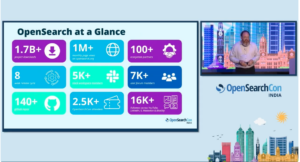
Today, the project has crossed a staggering 1.7 billion downloads, features 140 GitHub repositories, handles a steady release cadence every eight weeks, and has seen a 16% increase in contributors this year.
Building the core infrastructure for the agentic era
Far from being replaced by AI, OpenSearch is the engine driving it forward. The community has recently delivered unbelievable performance gains, including a 5.5x speedup on vector retrieval, alongside native LLM-as-a-judge capabilities and UI-based judgment sets.
With the launch of the OpenSearch relevance agent, the platform is using multi-agent systems to automate search relevance tuning, flattening the expertise barrier so that small developer shops can achieve the same search quality as massive enterprises.
Don’t stay left behind: Watch the session
The keynote closed with a powerful tribute to the community. Out of 10,000 global user group members, roughly 5,000 are based in India, proving that the region is a massive cornerstone of global search and analytics innovation.
Code is just bits on a screen, the community is what makes it a movement.
If you want to understand where search, observability, and agentic AI are colliding, you cannot afford to skip this talk. Watch the full keynote from OpenSearchCon India 2026 now.
Ready to connect with the “community of problems”? Dive into the OpenSearch Project GitHub, jump into the community Slack, or join a local OpenSearch User Group to help build the future of open-source search.