
TL;DR: OpenSearch 3.7 lets you retrieve vectors via docvalue_fields instead of _source, reading them straight from the columnar store in a single seek. Result: 5.5× faster end-to-end latency and 14.7× faster server-side processing at k=1000 — no reindexing required, works on all existing indexes and vector types. Use Base64 binary format for 70% smaller response payloads. Best for large-k RAG pipelines, reranking, and any workflow that needs vectors back in the response. |
Vector search doesn’t end at finding nearest neighbors. Many real-world applications need the vectors themselves returned in the response. For example, retrieval-augmented generation (RAG) pipelines fetch context embeddings for downstream large language model (LLM) calls, reranking systems compute cross-encoder scores, and client-side post-processing applies diversity or business-rule filtering. As k grows (k=100, k=500, or even k=1000), the cost of returning those vectors starts to dominate total query latency.
OpenSearch 3.7 introduces an optimized way to retrieve vectors from their columnar stored format using docvalue_fields, bypassing the expensive _source vector reconstruction path. The feature requires no reindexing, works on all existing older indexes, and supports all vector data types. The results: 5.5x faster end-to-end latency and 14.7x faster server-side processing at k=1000.
The traditional _source retrieval path
To understand why this matters, consider what happens when you request vectors in search results using the traditional _source path.
Starting with OpenSearch 3.0, vectors are no longer stored in the .fdt (stored fields) file. Instead, they are stored in a columnar format in the .vec file—a structure optimized for sequential vector access. This change was introduced as part of derived source for vectors, which reduced storage costs by up to 3x.
However, when you request vectors using _source, OpenSearch still follows the following multi-step reconstruction process:
- Read the compressed
_source(without vectors) from the.fdtfile on disk. - Decompress the stored field data.
- Deserialize the raw bytes into a document map.
- Read the vector from the
.vecfile and inject it into the deserialized document at the correct field path. - Reserialize the entire document back to JSON bytes in order to return it in the response.
Every one of these steps runs per document. At k=1000 with 768-dimensional vectors, that means reading, decompressing, deserializing, injecting, and re-serializing roughly 8 MB of response data per query.
In our benchmarks, this reconstruction overhead alone can add up to tens of milliseconds per query at high k values—time spent entirely on marshaling data that already exists in a readily accessible columnar format. The vector is right there, stored in a columnar structure optimized for sequential access. Reading it through _source is unnecessarily indirect.
Retrieving vectors directly from the columnar store
Vector retrieval using doc values separates vectors from non-vector fields in the response. Instead of routing vectors through the _source reconstruction pipeline described in the preceding section, OpenSearch leaves _source untouched and reads vectors directly from the columnar store with a single seek per document. The vectors are then returned in a separate fields key in the response.
Non-vector fields (title, text, metadata) continue to be served from _source as before. By keeping vectors out of the _source path entirely, vector injection (the most expensive step in the reconstruction pipeline) is eliminated without modifying or reprocessing the original document source.
The following diagram compares the two retrieval paths:
Doc values path (per document):

  Non-vector fields:  .fdt (disk) ──► Decompress ──► Deserialize ──► Response
  Vector field:       Columnar store ──► Vector bytes ──► Encode ──► Response

  No vector injection into _source. No re-serialization of the full document.
The doc values retrieval process
The knn_vector field type now supports the docvalue_fields parameter in search requests. When you request a vector field through docvalue_fields, OpenSearch performs the following steps:
- Looks up the document’s ordinal in the columnar vector store.
- Reads the raw vector bytes directly in a single, sequential read.
- Encodes the vector in the requested format (Base64 binary or JSON array).
The vector retrieval is completely independent of _source. The stored fields file is never accessed for vector data. OpenSearch skips the decompression-injection-reserialization pipeline entirely for vectors.
Output formats
Vector retrieval using doc values supports the following output formats.
| Format | Description | Response size (768-dim, k=1000) | Best for |
|---|---|---|---|
binary (default) |
Base64-encoded little-endian float bytes | ~2.5 MB | Programmatic clients, performance-critical paths |
array |
JSON numeric array | ~6 MB | Debugging, human inspection, simple clients |
The binary format is the default because it produces responses roughly 60% smaller than JSON arrays for high-dimensional vectors. This reduces the amount of data to serialize on the server, transfer over the network, and parse on the client.
Compatibility
Vector retrieval using doc values works with:
- All k-NN engines: Lucene, Faiss, and NMSLIB
- All vector data types:
float,byte, andbinary - All compression levels: No restrictions on quantization settings
- Existing indexes: No reindexing required—works on indexes created with any prior OpenSearch version
Using doc values for vector retrieval
The following examples show different ways to retrieve vectors using docvalue_fields.
Basic usage (binary format, the default)
POST /my_index/_search
{
  "query": {
    "knn": {
      "my_vector": {
        "vector": [0.1, 0.2, 0.3, ...],
        "k": 100
      }
    }
  },
  "docvalue_fields": ["my_vector"],
  "_source": false
}
Specifying format explicitly
POST /my_index/_search
{
  "query": {
    "knn": {
      "my_vector": {
        "vector": [0.1, 0.2, 0.3, ...],
        "k": 100
      }
    }
  },
  "docvalue_fields": [
    {"field": "my_vector", "format": "binary"}
  ],
  "_source": false
}
Excluding vectors from _source and use doc values
We recommend excluding the vector field from _source and retrieving it through docvalue_fields. This way, you still get the full document metadata from _source (title, text, timestamps) without the overhead of vector reconstruction, while the vector comes directly from the columnar store:
POST /my_index/_search
{
  "query": {
    "knn": {
      "my_vector": {
        "vector": [0.1, 0.2, 0.3, ...],
        "k": 100
      }
    }
  },
  "docvalue_fields": [{"field": "my_vector", "format": "binary"}],
  "_source": {
    "excludes": ["my_vector"]
  }
}
Using vectors only for maximum performance
If you only need the vectors and document IDs (for example, in a reranking pipeline), you can eliminate all _source and stored field overhead entirely. This request returns only the document ID and vector bytes:
POST /my_index/_search
{
  "query": {
    "knn": {
      "my_vector": {
        "vector": [0.1, 0.2, 0.3, ...],
        "k": 1000
      }
    }
  },
  "stored_fields": "_none_",
  "docvalue_fields": ["_id", {"field": "my_vector", "format": "binary"}],
  "_source": false
}
Response format
Binary format:
{
  "hits": {
    "hits": [
      {
        "_id": "doc_1",
        "_score": 0.95,
        "fields": {
          "my_vector": ["AACAPwAAAEAAAEBAAACAQA=="]
        }
      }
    ]
  }
}
In this response, the Base64 string decodes to the raw float bytes in little-endian order. Most client libraries (Python’s struct, Java’s ByteBuffer, NumPy’s frombuffer) can decode this directly.
Array format:
{
  "hits": {
    "hits": [
      {
        "_id": "doc_1",
        "_score": 0.95,
        "fields": {
          "my_vector": [[1.0, 2.0, 3.0, 4.0]]
        }
      }
    ]
  }
}
Benchmark results
We benchmarked vector retrieval using doc values against traditional _source retrieval to measure the real-world improvement across different configurations.
Setup
The benchmarks used the following configuration:
- Dataset: Cohere-1M (1,000,000 vectors, 768 dimensions)
- Cluster: 3× r8id.4xlarge (16 vCPUs, 128 GB RAM each)
- Index configuration: 1 shard, 2 replicas, Hierarchical Navigable Small World (HNSW) with Faiss,
ef_construction=128,m=16,ef_search=32 - Force merged to 1 segment per shard
- Queries: 10,000 queries, single-threaded, direct node connection
- Client: OpenSearch Python client (
opensearch-py) with connection pooling
Results at k=1000
At k=1000, the improvement is dramatic because _source overhead dominates, as shown in the following image.
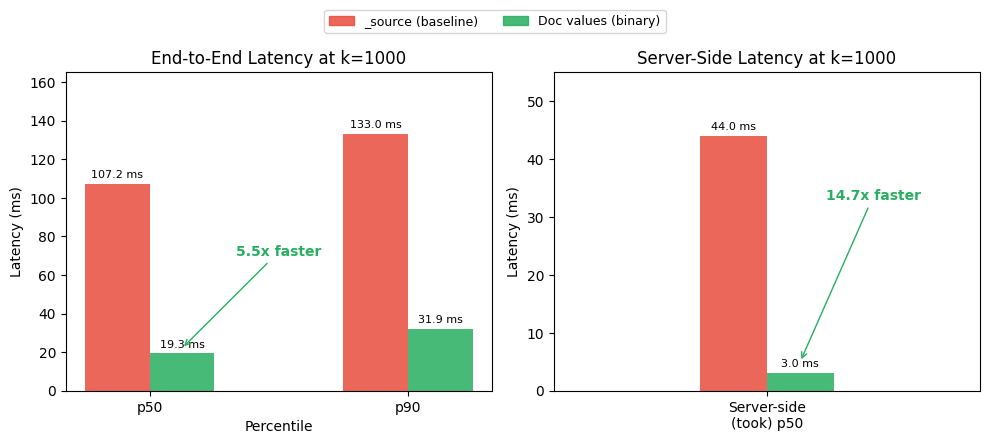
The following table shows the latency comparison at k=1000.
| Method | E2E p50 | E2E p90 | Server-side (took) p50 | Improvement (E2E p50) | Improvement (server-side p50) |
|---|---|---|---|---|---|
_source (baseline) |
107.2 ms | 133.0 ms | 44.0 ms | — | — |
| Doc values (binary) | 19.3 ms | 31.9 ms | 3.0 ms | 5.5x | 14.7x |
Server-side improvement: 44 ms → 3 ms (14.7x faster)
The entire _source overhead (decompression, deserialization, vector injection, re-serialization) is eliminated. The remaining 3 ms is the k-NN graph search itself.
Results at k=100
At k=100, the improvement is smaller because fixed costs (k-NN search, network round-trip time) represent a larger share of total latency, as shown in the following image.
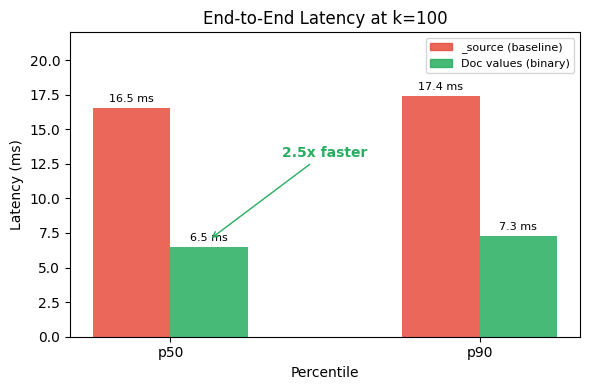
The following table shows the latency comparison at k=100.
| Method | E2E p50 | E2E p90 | Server-side (took) p50 | Improvement (E2E p50) |
|---|---|---|---|---|
_source (baseline) |
16.5 ms | 17.4 ms | 8.0 ms | — |
| Doc values (binary) | 6.5 ms | 7.3 ms | 3.0 ms | 2.5x |
Even at moderate k values, you save meaningful latency—especially at the server level, where stored field reads drop from 8 ms to 3 ms.
CBOR transport
For applications using binary transport protocols such as Concise Binary Object Representation (CBOR) or Smile, the improvement is even more pronounced because the _source path is particularly expensive with these formats, as shown in the following table.
| Method | Transport | E2E p50 | Improvement compared to _source CBOR |
|---|---|---|---|
_source (baseline) |
CBOR | 92.3 ms | — |
| Doc values (binary) | CBOR | 17.8 ms | 5.2x |
Latency breakdown by component
To understand why the improvement is so large at k=1000, consider the cost breakdown shown in the following image.
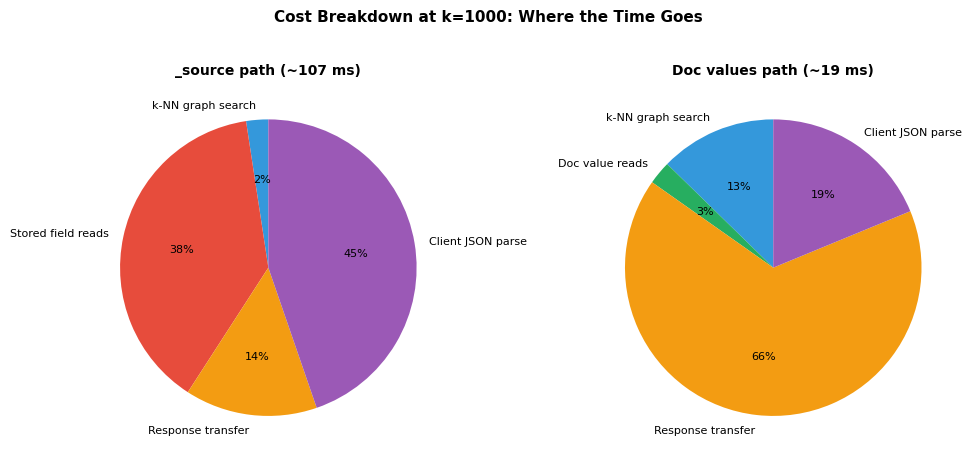
The following table presents the time spent in each component.
| Component | _source Path |
Doc values path | Scales with k? |
|---|---|---|---|
| k-NN graph search | ~2–3 ms | ~2–3 ms | No |
| Stored field reads | ~40 ms | 0 ms | Yes (linear) |
| Doc value reads | 0 ms | < 1 ms | Negligible |
| Response transfer | ~15 ms | ~13 ms | Yes (linear) |
| Client JSON parse | ~46 ms | ~3.7 ms | Yes (linear) |
| Total E2E | ~107 ms | ~19 ms |
The stored field reads (40 ms) and client-side JSON parsing (46 ms compared to 3.7 ms for compact Base64 encoding) account for most of the latency reduction.
Response payload comparison
The following image compares response payload sizes across retrieval methods.
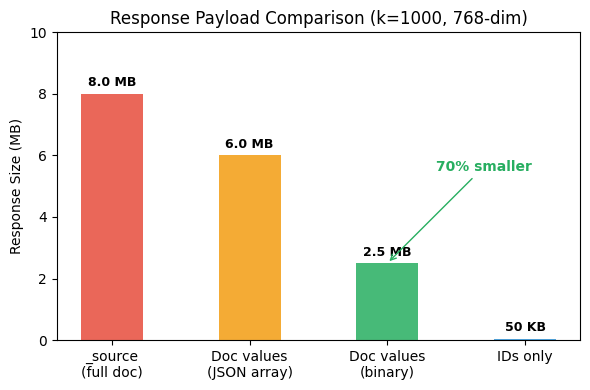
The following table lists the response sizes for each method.
| Method | Response size (k=1000, 768-dim) |
|---|---|
_source (full document) |
~8 MB |
| Doc values (JSON array) | ~6 MB |
| Doc values (binary/Base64) | ~2.5 MB |
| IDs only (no vectors) | ~50 KB |
Binary encoding delivers a 70% reduction in response payload compared to full _source retrieval.
When to use vector retrieval using doc values
Vector retrieval using doc values is most impactful when:
- k is large (k=100+) –
_sourceoverhead scales linearly with the number of returned documents. - RAG pipelines – fetching context embeddings to pass to an LLM, where you need vectors but not the full document source.
- Re-ranking workflows – retrieving vectors for client-side or cross-encoder rescoring.
For queries in which you don’t need the vectors in the response (the common case for user-facing search), continue using _source.excludes to exclude the vector field. This remains the fastest option because no vector bytes are transferred at all.
What’s next: Binary vector ingestion in OpenSearch 3.8
Vector retrieval using doc values solves the performance problem on the retrieval side. But what about ingestion?
Today, vectors are sent to OpenSearch as JSON numeric arrays. A 768-dimensional float vector becomes a JSON array of 768 numbers, consuming approximately 6 KB on the wire per vector. OpenSearch 3.8 will introduce Base64 binary vector ingestion, in which clients send vectors as compact Base64-encoded byte strings instead of JSON arrays.
Combined with vector retrieval using doc values, this will create a complete binary round trip: ingest vectors as Base64 values, store them efficiently, and retrieve them as Base64 values; no JSON numeric array parsing at any point in the request lifecycle.
Conclusion
OpenSearch 3.0 introduced derived source for vectors, which reduced storage costs by up to 3x by removing vectors from _source. In OpenSearch 3.7, vector retrieval using doc values eliminates the most expensive part of reading vectors: the _source decompression and reserialization pipeline. By reading vectors directly from the columnar stored format and encoding them as compact Base64 strings, OpenSearch delivers 5.5x faster end-to-end latency at k=1000 with a single query parameter change.
To get started, see the documentation:
- Retrieve vectors using doc values – Performance tuning guide
- Retrieving vector fields using docvalue_fields – Guide for retrieving specific fields
We’d love to hear about your experience. Join the conversation on the OpenSearch forum or open an issue on GitHub.